
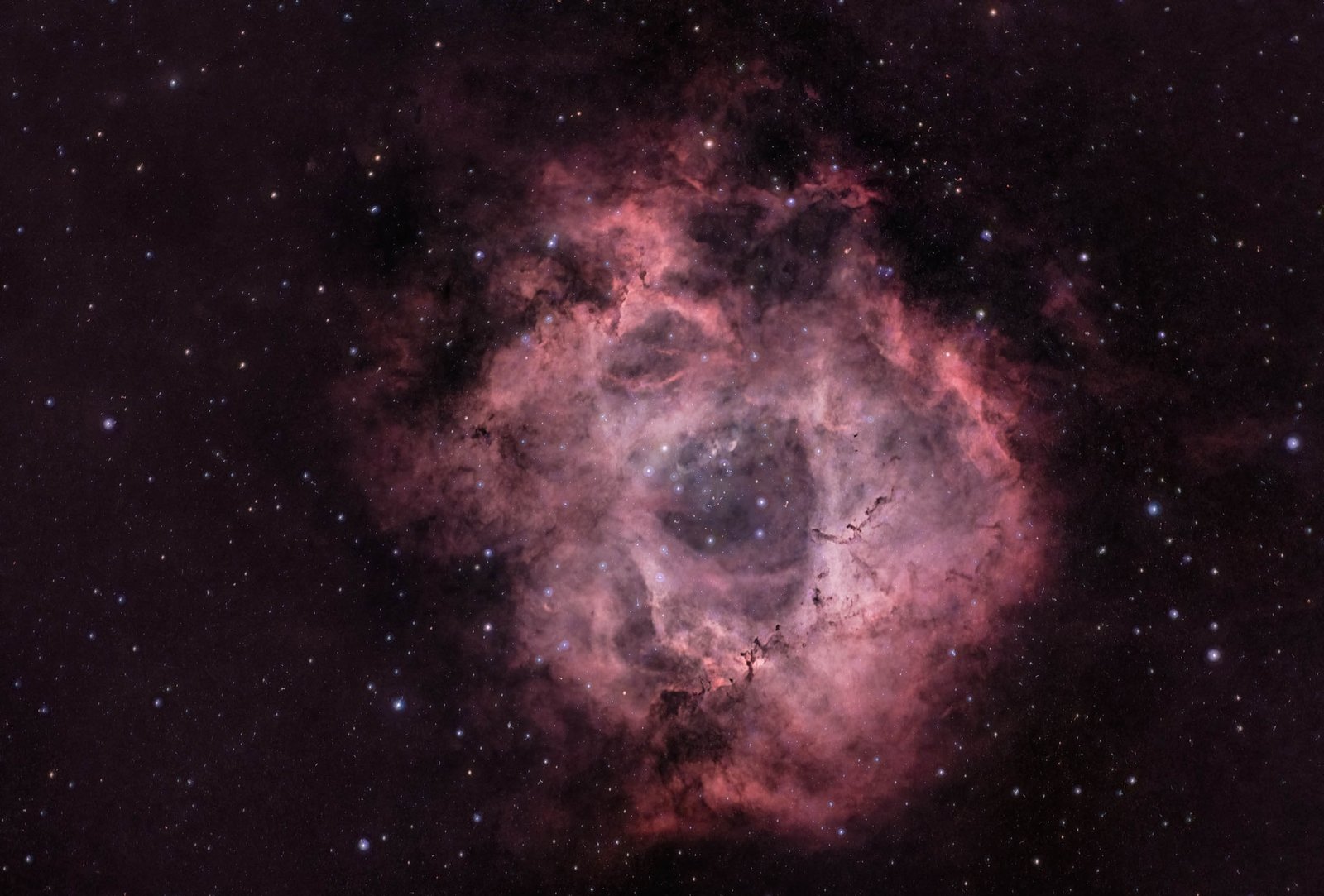
In the quiet depths of the winter sky lies a celestial object that truly lives up to its name; the Rosette Nebula. With its delicate, flower-like structure and sprawling clouds of glowing gas, this deep-sky target is both a visual delight and a rewarding challenge for astrophotographers.
What is the Rosette Nebula?
The Rosette Nebula (NGC 2237–2239) is a vast emission nebula located in the constellation Monoceros, about 5,000 light-years from Earth. At its heart lies a young open star cluster (NGC 2244), whose intense radiation carves out the central cavity and energizes the surrounding الغاز, causing it to glow in deep red hues.
Unlike brighter objects like Orion’s Nebula, the Rosette is more subtle and expansive—making it a perfect subject for wide-field imaging and longer integration times.
Why Photograph the Rosette?
The Rosette Nebula offers a unique combination of structure and scale.
Intricate Petal-Like Formation: Its circular symmetry and dark dust lanes resemble a blooming rose.
Rich Hydrogen Emission: Strong H-alpha signal makes it ideal for narrowband imaging.
Wide Field Appeal: Best captured with shorter focal lengths to frame the entire nebula.
It’s a target that rewards patience and careful technique.
Equipment Recommendations
Capturing the Rosette Nebula benefits from a slightly more refined setup:
Camera: Modified DSLR or dedicated astronomy camera (especially for H-alpha sensitivity).
Lens/Telescope: A refractor in the 250mm–600mm range works beautifully.
Mount: Equatorial mount with accurate tracking is essential for longer exposures.
Filters: Narrowband filters (H-alpha, OIII, SII) for city skies. Light pollution filters for broadband imaging
When and Where to Shoot
The Rosette Nebula is best visible from December through March in the Northern Hemisphere. It sits in Monoceros, near the bright star Betelgeuse and the constellation Orion.
For best results:
Shoot on moonless nights.
Aim for when the nebula is highest in the sky.
Travel to darker skies if possible
Exposure Strategy:
The Rosette is much fainter than M42, so longer total integration is key:
– Sub-exposures: 120–300 seconds (depending on tracking and sky conditions).
ISO/Gain: ISO 800–1600 (DSLR) or appropriate gain for astro cameras
– Total Integration: Aim for at least 2–6 hours
– If using narrowband filters, exposures may need to be even longer to capture sufficient signal.
Processing the Rosette
Processing is where the Rosette truly comes alive:
– Stack your frames using DeepSkyStacker, Siril, or PixInsight.
– Stretch the image to reveal faint outer التفاصيل.
– Enhance contrast to bring out dark dust lanes.
Color mapping:
– Natural color for DSLR images.
– Hubble palette (SII, H-alpha, OIII) for narrowband.
– The goal is to highlight the nebula’s soft gradients while preserving its structure.
Challenges to Expect:
Low Surface Brightness: Requires long integration time
Framing: Too much focal length can crop out the nebula’s full shape.
Noise: Longer exposures and stacking help mitigate this
Light Pollution: Narrowband filters can dramatically improve results.
Final Thoughts
Photographing the Rosette Nebula is less about instant gratification and more about patience and persistence. It won’t dazzle in a single exposure—but over hours of collected light, it slowly reveals its elegant structure.
There’s something poetic about capturing a cosmic “flower” blooming thousands of light-years away. With the right approach, you can turn faint photons into a striking image that feels both delicate and immense.
So bundle up, point your scope toward Monoceros, and let the Rosette bloom in your camera sensor.