
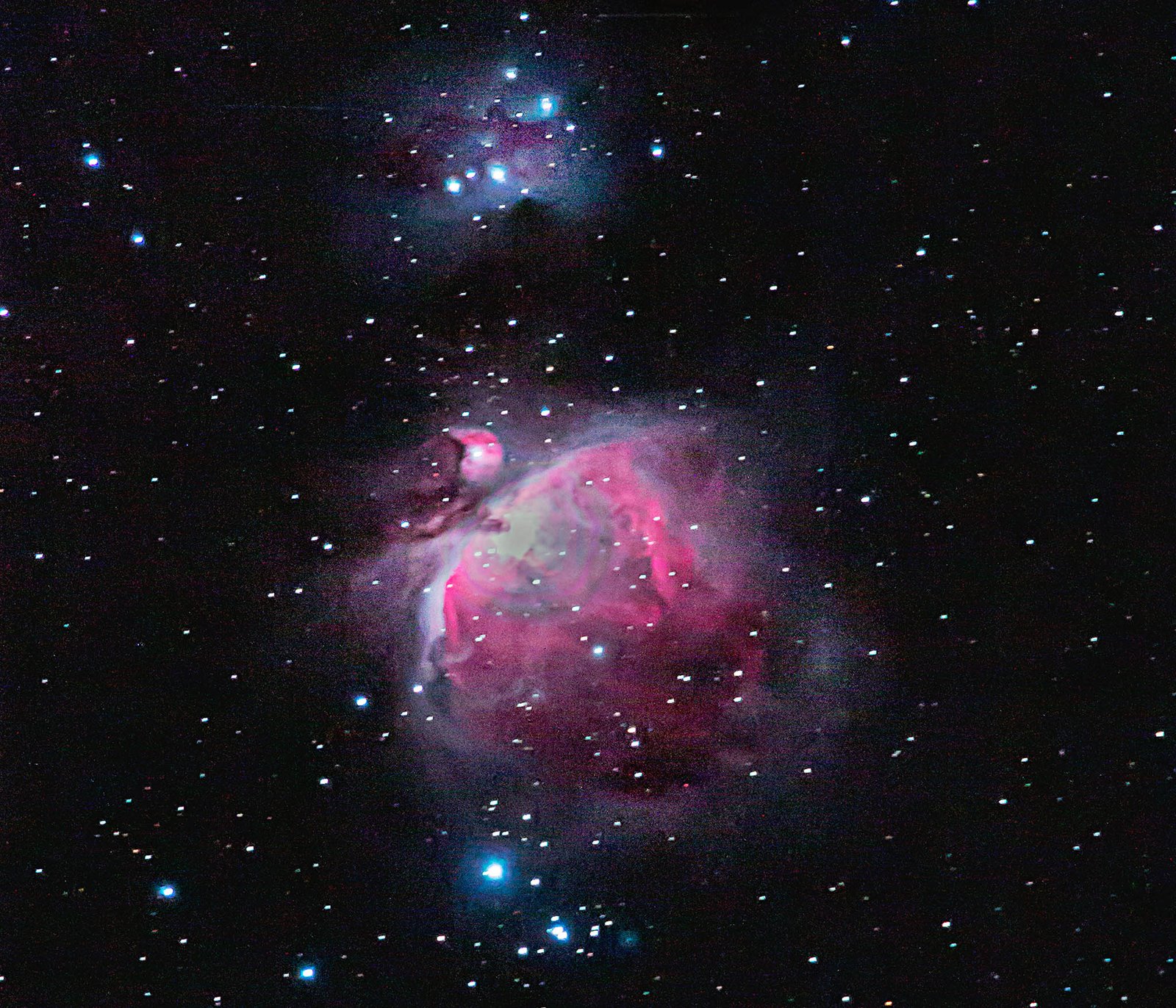
There are few objects in the night sky as breathtaking—and rewarding to photograph—as the Orion Nebula (M42). Hanging like a cosmic jewel in the sword of Orion, this stellar nursery is one of the brightest nebulae visible from Earth, making it a perfect target for both beginners and seasoned astrophotographers.
To help you master this, we have put together this guide to photographing Orion.
Why M42 is Special
M42 isn’t just another faint smudge in the sky—it’s a massive cloud of gas and dust where new stars are actively forming. Located about 1,300 light-years away, it glows with vibrant reds, pinks, and subtle blues due to ionized hydrogen and other gases. At its core lies the Trapezium Cluster, a group of young, hot stars that illuminate the surrounding nebula.
What makes M42 especially appealing is its brightness. Unlike many deep-sky objects, it can be seen with the naked eye under dark skies and captured even with modest equipment.
Gear You’ll Need
You don’t need a professional observatory to image M42. A simple setup can yield impressive results:
– Camera: A DSLR or mirrorless camera works great.
– Lens or Telescope: A telephoto lens (200mm–400mm) or a small refractor telescope.
– Mount: A star tracker or equatorial mount is highly recommended to avoid star trails.
– Tripod: Stable and sturdy—no compromises here.
Best Time to Photograph
M42 is best visible during the winter months in the Northern Hemisphere, typically from November through February. Aim to shoot when Orion is high in the sky—this reduces atmospheric distortion and improves image clarity.
Clear, dark skies are key. Avoid nights with a bright moon, as it can wash out the nebula’s faint details.
Camera Settings and Exposure
One of the biggest challenges with M42 is its dynamic range. The core is extremely bright, while the outer regions are faint. To capture both:
– ISO: Start around 800–1600.
– Exposure: Take a mix of short exposures (10–30 seconds) for the core and longer exposures (60–120 seconds) for the outer nebula.
– Aperture: Use the widest aperture your lens allows (e.g., f/2.8–f/5.6).
– Focus: Manual focus on a bright star using live view.
This technique, known as exposure blending or HDR stacking, helps preserve detail across the entire nebula.
Stacking and Processing
Your raw images will look underwhelming at first—that’s normal. The magic happens in post-processing:
1. Stack your images using software like DeepSkyStacker or Siril.
2. Stretch the histogram to bring out faint details.
3. Adjust color balance to highlight the nebula’s natural hues.
4. Reduce noise carefully to maintain sharpness.
Patience here pays off. Subtle adjustments can dramatically improve your final image.
Common Challenges
– Overexposed Core: Without shorter exposures, the center will appear blown out.
– Light Pollution: Even moderate pollution can reduce contrast—consider using a light pollution filter.
– Tracking Errors: Poor alignment leads to star trails; take time to polar align your mount accurately.
Final Thoughts
Photographing M42 is a rite of passage in astrophotography. It’s bright enough to be accessible, yet complex enough to challenge your skills in both capture and processing. Every attempt reveals something new—finer detail, richer color, better contrast.
The Orion Nebula reminds us that even in the cold emptiness of space, creation is ongoing. And with a bit of patience and curiosity, you can capture a piece of that story from your own backyard.
Clear skies!