A Night Above the Clouds
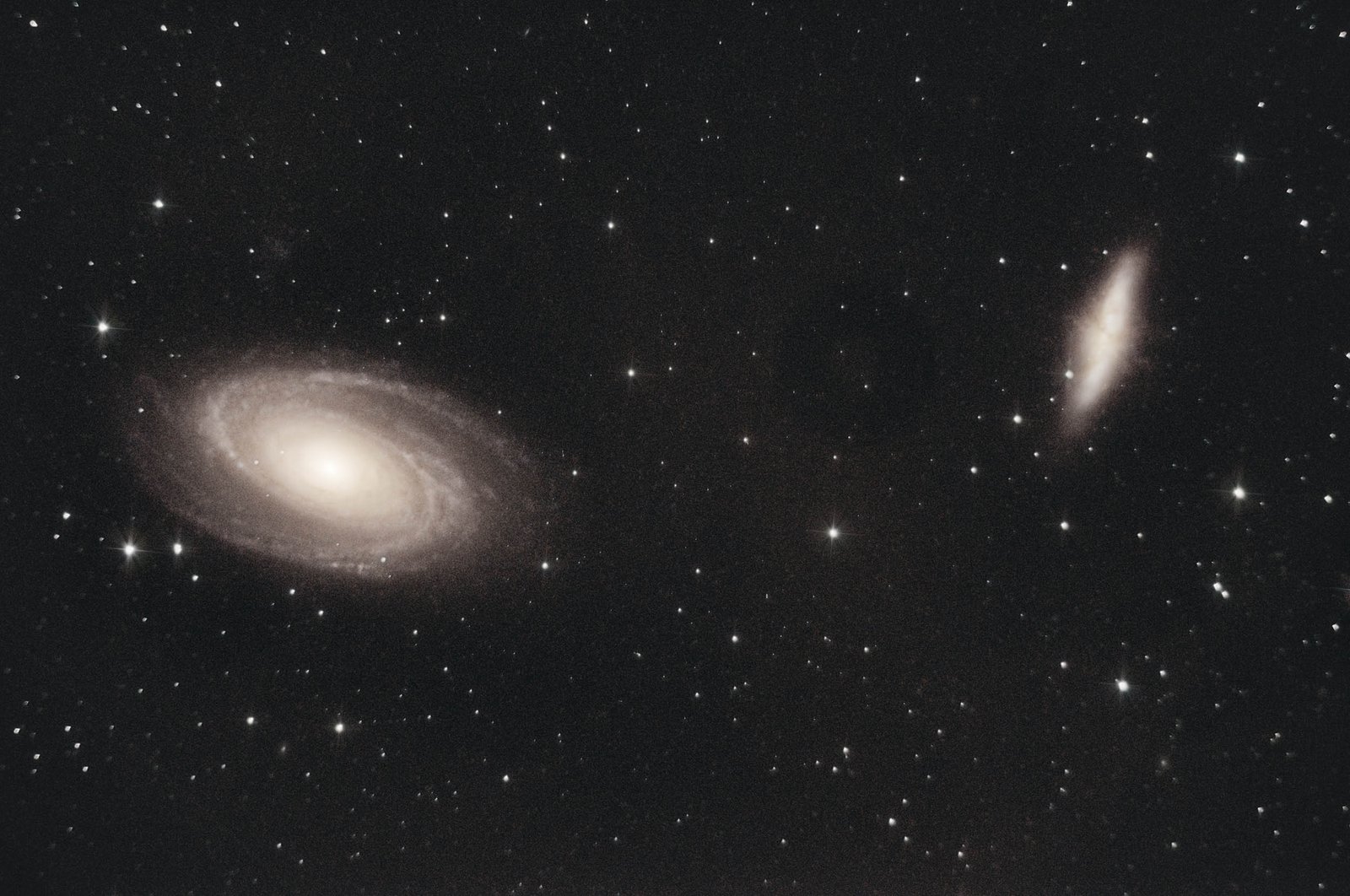
There’s something surreal about setting up a telescope at 2,200 meters above sea level, surrounded by volcanic rock and silence, while a sea of clouds drifts far below. This was my experience photographing M81 (Bode’s Galaxy) and M82 (Cigar Galaxy) from the slopes of Mount Teide in Tenerife.
At this altitude, the sky feels closer—darker, steadier, and incredibly transparent. It’s the kind of place where galaxies don’t just appear… they emerge.
Why Tenerife is Special for Astrophotography
The Canary Islands are home to some of the best observing conditions in the world, and it’s easy to see why:
- Altitude (~2200m): Above much of the atmospheric turbulence
- Stable air (low seeing distortion): Sharper stars, finer detail
- Low light pollution: Especially within Teide National Park
- Cloud inversion layer: A blanket of clouds blocks city lights below
Compared to imaging from the UK, the difference is dramatic—more contrast, better signal, and far less atmospheric interference.
The Targets: A Tale of Two Galaxies
Bode's Galaxy
A calm, majestic spiral galaxy with sweeping arms and a bright core. Under Tenerife’s pristine skies, its dust lanes and subtle color variations become far easier to capture.
Messier 81 is a grand design spiral galaxy about 12 million light-years away in the constellation Ursa Major. It has a D₂₅ isophotal diameter of 29.44 kiloparsecs.
Cigar Galaxy (M82)
A completely different beast—distorted, turbulent, and bursting with star formation. The real highlight here is the faint red hydrogen gas being ejected from its core, which benefits hugely from dark skies and long exposures.
M82 Galaxy Messier 82 is a starburst galaxy approximately 12 million light-years away in the constellation Ursa Major. It is the second-largest member of the M81 Group, with the D₂₅ isophotal diameter of 12.52 kiloparsecs.
Imaging Setup & Capture
On this trip, I aimed to take full advantage of the conditions:
- Focal length: ~400–600mm to frame both galaxies
- Mount: Portable equatorial mount (essential for travel)
- Camera: Cooled astro camera
- Filters: LRGB + H-alpha for M82
Exposure Strategy
- Subframes: 180–300 seconds
- Total integration: ~8–12 hours over multiple nights
- The transparency at altitude meant I could push exposure times confidently without losing detail to sky glow.
What Makes High-Altitude Imaging Better?
- Increased Signal-to-Noise Ratio
With less atmosphere to shoot through, more of the galaxies’ light reaches the sensor cleanly. - Sharper Detail (Better Seeing)
Fine structures—like M81’s spiral arms and M82’s filamentary outflows—appear more defined. - Reduced Light Pollution
The cloud layer below acts like a natural filter, blocking artificial light. - Better Transparency
Faint features like integrated flux nebula (IFN) become more accessible.
Processing the Data
- Back home, the data really showed its quality:
- Minimal gradient removal needed
- Strong signal in fewer hours compared to UK sessions
- H-alpha data cleanly revealed M82’s gas jets
Processing focused on:
- Enhancing M81’s natural color balance
- Carefully blending H-alpha into M82
- Preserving the contrast between the two galaxies
The Final Result
Framing both galaxies together tells a deeper story. These aren’t just neighbors—they’re interacting, shaping each other over millions of years.
- M81: structured, elegant, stable
- M82: chaotic, explosive, evolving
- Under Tenerife’s skies, that contrast becomes even more striking.
Final Thoughts
Imaging Messier 81 and Messier 82 from 2,200 meters in Tenerife wasn’t just about better data—it was about perspective.
Above the clouds, with the Milky Way arching overhead and galaxies glowing faintly in the distance, you’re reminded that astrophotography isn’t just technical—it’s deeply human.